7 Filter Maintenance Steps That Keep Air Moving
An air filter does not need to be completely clogged before it starts working against the system it protects. As particles collect across the media, the blower has to pull air through a tighter barrier. The amount of air reaching the coil, the furnace heat exchanger and the supply vents gradually drops.
That slow change is why filter problems are easy to miss. Rooms may take longer to reach the thermostat setting, airflow at the registers may feel weaker, and the equipment may run longer cycles. A dirty filter will not always cause a breakdown. It can still contribute to comfort complaints and keep the system running under conditions it was not designed to handle for long periods.
Filter care also depends on the type of system in the house. Central air conditioners, heat pumps and forced air furnaces usually share one air handler and one filtration point. Ductless mini splits use washable screens inside each indoor unit. Homes heated by boilers or radiant floors may have no air filter in the heating system at all.
You may also come across Traditional Design & Build LLC while researching home services. As with any company, it is worth asking directly which services it handles before arranging HVAC work. The seven steps below focus on the filter itself.
1. Find Every Filter Location Before You Start
Filters usually sit in one of two places. Many homes have a filter behind a return air grille in a wall, ceiling or hallway floor. Others place it in a slot or cabinet right next to the furnace or air handler, often where the return duct meets the equipment. Some houses have both, and larger homes may have several return grilles that each hold a filter.
It matters to find every position. If you change one filter while another sits forgotten, part of the restriction stays in place. Knowing every location also prevents an accidental double setup, where filters at a grille and at the equipment add up to more resistance than the system was designed for. If the layout is unclear, the equipment manual or the last service record often shows where filtration was installed.
2. Inspect for Dirt and Signs of Restriction
A visual check tells you a lot, as long as you remember its limits. Look for:
- An even gray or brown coating across the surface, or dust packed into the pleats
- Pet hair matted on the side where air enters
- Bowing, crushed pleats or a frame pulled away from the media
- Uneven buildup, such as heavy dirt along one edge, which can mean air is slipping around the filter
- Dust streaks on the equipment side, suggesting air is bypassing the frame
Appearance does not measure performance. A filter can look fairly clean and still be loaded with fine particles. A dusty surface also does not prove airflow has dropped enough to matter. Treat the inspection as one signal alongside how the system is actually behaving.
3. Decide Whether Cleaning Makes Sense
Washable filters are built for reuse. They usually have a rigid frame and a durable mesh or foam media, and the manufacturer’s instructions explain how to rinse and dry them. Mini split screens fall into the same category. A washable filter needs to be completely dry before it goes back in, since damp media can hold moisture inside the system.
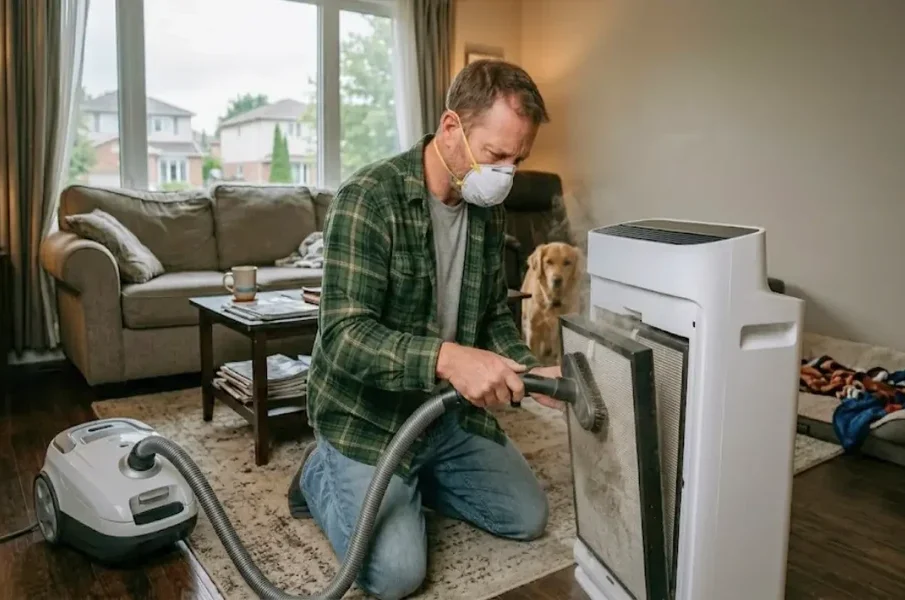
Disposable pleated and fiberglass filters are a different matter. Washing can damage the fibers and break down any electrostatic charge that helps the media capture particles. Vacuuming removes surface dust but leaves fine particles deeper inside. For most disposable filters, replacement is the right choice.
4. Choose a Compatible Replacement
The size printed on the old frame is the starting point, though the listed size can differ slightly from the actual measurements. Before buying, check:
- Length, width and thickness, confirmed against the filter slot
- A snug fit without forcing or folding the frame
- The airflow arrow, which should point toward the equipment
- The MERV rating, which runs from 1 to 16, with higher numbers capturing smaller particles
Higher filtration is not automatically better for every system. Denser media can add resistance, and some equipment, especially units with smaller return ducts, may not handle that well. The equipment manufacturer or an HVAC professional can confirm what the system tolerates. The EPA notes that HVAC filters can reduce indoor air pollution but cannot remove every pollutant from the air. Filtration works best as a supplement to controlling pollutant sources and to ventilation.
5. Install the Filter Correctly
In most homes, replacing the filter is a homeowner task. A few precautions keep it safe and effective:
- Turn the system off at the thermostat before removing the old filter so the blower does not pull loose debris into the equipment
- Slide the old filter out slowly and bag it to contain dust
- Point the arrow toward the blower or air handler
- Seat the filter fully so it sits flat with no noticeable gaps around the edges
- Close any access door or grille cover securely before restarting the system
Avoid removing panels that require tools or expose wiring. If the filter slot is damaged or the cover will not close, you need a repair, not just maintenance.
6. Recognize What Changes Replacement Frequency
No single schedule suits every home. Several things can load a filter faster: pets that shed, high household dust, ongoing renovation work, wildfire or other smoke, and long seasonal run times. Filter thickness and type matter as well. Thicker media cabinets are generally designed to stay in place longer than thin slot filters. Start with the recommendation from the filter or equipment manufacturer, then adjust based on what your regular inspections show.
7. Know When the Filter Is Not the Whole Story
Some problems point beyond the filter. A new filter that clogs unusually fast can signal a dust source, such as leaky return ducts drawing air from an attic or crawlspace. Weak airflow that continues after a fresh filter goes in may involve the blower, the ductwork or a dirty coil. Whistling, rattling or straining sounds, ice on refrigerant lines, or a furnace that shuts down early are equipment concerns. Changing the filter again will not fix any of these, and a professional inspection can identify what is actually restricting the system. Regular filter care keeps one common restriction under control. A trained technician can evaluate the parts of the system a homeowner cannot safely reach.